26 January 2011

When the winter comes, let’s go South! The Red Sea Dolphin Project


Some Tethys members are very similar to some baleen whales: when the winter comes they migrate South. However, to avoid any misunderstanding, it is NOT a matter of travelling to warm-water breeding ground.
In collaboration with the Hurghada Environmental Protection and Conservation Association (HEPCA), a non-governmental organization working in the field of marine and land conservation in Egypt, and with the Italian Cooperation, three Italian biologists are engaged in the first research plan completely dedicated to the study of dolphins and whales in the Southern Egyptian Red Sea, under the supervision of Giuseppe Notarbartolo di Sciara: the Red Sea Dolphin Project.
This boat-based research project intends to investigate some of the most pristine areas of the Egyptian waters with the main aims to contribute to the existing knowledge of Red Sea cetaceans and advance our understanding of their ecology, abundance and distribution.
The project represents also a rare and extraordinary opportunity for enthusiastic people willing to contribute to conservation while bringing awareness to the Red Sea by promoting sustainable tourism development for the region. The participants will be part of a unique, interactive, and science-based experience, assisting the researchers, observing and studying dolphins in their natural environment.
If you wish to find out more about the program visit the Red Sea Dolphin Project blog: http://redseadolphinproject.wordpress.com. Or contact booking@hepca.com for your enquires.

Amina Cesario, Marina Costa, Maddalena Fumagalli

http://vimeo.com/18951997

18 January 2011

New Findings on the Effects of Noise on the Behavior of Whales and Dolphins

Video conference by Brandon Southall (Smithsonian's National Museum of Natural History) on the "SOCAL-10" project aimed at evaluating the behavioral responses of cetaceans to underwater human-produced sounds, particularly military sonar.

Videoconferenza sulle risposte comportamentali dei cetacei a suoni prodotti dall'uomo in mare, in particolare da sonar militari (in inglese).

http://www.ustream.tv/recorded/11956611

22 November 2010

Bottlenose dolphin movements in Greece

Based on work done by Tethys in the coastal waters of western Greece, new information on bottlenose dolphin movements has become available.

A recent paper published in the Journal of Ecology reports movements of nine individual dolphins observed across three different study areas and photoidentified up to 265 km apart.

---
Image: Location of the three study areas in Greece, and movements by nine bottlenose dolphins. From Bearzi et al. 2010.

Bearzi G., Bonizzoni S., Gonzalvo J. 2010. Mid-distance movements of common bottlenose dolphins in the coastal waters of Greece. Journal of Ethology. DOI: 10.1007/s10164-010-0245-x 
ABSTRACT: While bottlenose dolphins in Mediterranean waters often display a high level of site fidelity, movements across distant areas can occur. Such movements have important implications in terms of population viability, particularly in basins with low bottlenose dolphin densities. We report movements of nine individuals photoidentified up to 265 km apart in western Greece. Four showed a certain degree of site fidelity to one area across several years, but were also found elsewhere, with two individuals moving between two areas. This study provides further evidence that animals appearing to be ‘resident’ within a given area can temporarily leave and range widely.

20 November 2010

Australian white sharks in the Mediterranean Sea


Some cetaceans and birds are known to perform long-distance movements. Now, a recent study explains how white sharks could also be added to this ‘record’ list. Researchers found out that white sharks living in the Mediterranean Sea are closely related to those living in Australian waters.

About 450,000 years ago, while some individuals were swimming between Australia and Africa, strong abnormal currents deviated their routes and probably led them to the west coast of Africa. Once there, they would have tried in vain to head east again to go back on their route but ended in the Mediterranean.

"Once they got to the Mediterranean they may have become trapped because its peninsulas and channels make it like a giant lobster pot (…) But because white shark females return to the area where give birth, once they birth in the Mediterranean they become a fixture, shaping and rebalancing the ecosystem" commented Jones, one of the authors.

SB

---Image: ‘Bruce’ the white-shark in the famous cartoon ‘Finding Nemo’.

Gubili C., Bilgin R., Kalkan E., Karhan S.U., Jones C.S., Sims D.W., Kabasakal H., Martin A.P., Noble L.R. 2010. Antipodean white sharks on a Mediterranean walkabout? Historical dispersal leads to genetic discontinuity and an endangered anomalous population. Proceedings of the Royal Society B. 10.1098/rspb.2010.1856

ABSTRACT: The provenance of white sharks (Carcharodon carcharias) in the Mediterranean is both a conundrum and an important conservation issue. Considering this species's propensity for natal philopatry, any evidence that the Mediterranean stock has little or no contemporary immigration from the Atlantic would suggest that it is extraordinarily vulnerable. To address this issue we sequenced the mitochondrial control region of four rare Mediterranean white sharks. Unexpectedly, the juvenile sequences were identical although collected at different locations and times, showing little genetic differentiation from Indo-Pacific lineages, but strong separation from geographically closer Atlantic/western Indian Ocean haplotypes. Historical long-distance dispersal (probably a consequence of navigational error during past climatic oscillations) and potential founder effects are invoked to explain the anomalous relationships of this isolated ‘sink’ population, highlighting the present vulnerability of its nursery grounds.

---
For more information:
http://www.telegraph.co.uk/science/science-news/8137374/Mediterranean-great-white-sharks-are-Australian.html
http://news.discovery.com/animals/aussie-great-white-shark-moms-made-mediterranean-home.html

To read the paper:
http://rspb.royalsocietypublishing.org/content/early/2010/11/16/rspb.2010.1856.full.pdf+html

08 November 2010

Sea turtles and plastic in the Adriatic Sea


A recent study conducted in the Adriatic waters focused on loggerhead sea turtle Caretta caretta and plastic debris.

Researchers from the University of Zagreb found that marine debris was ingested by 35% of loggerheads foraging in neritic habitats of the Adriatic Sea. Debris include plastic bags, wrapping foils, ropes, polystyrene foam and fishing line; but soft plastic was the most frequent found in digestive tract.

The high occurrence of debris intake represents a factor of concern for loggerheads in the Adriatic Sea. The researchers hope that, having shown that the turtles are particularly vulnerable to plastic debris, more will be done to reduce such debris.

SB

---
Lazar B., Gračan R. 2010. Ingestion of marine debris by loggerhead sea turtles, Caretta caretta, in the Adriatic Sea. Marine Pollution Bulletin. doi:10.1016/j.marpolbul.2010.09.013

Abstract - We examined the occurrence of marine debris in the gastrointestinal tract of 54 loggerhead sea turtles (Caretta caretta) found stranded or incidentally captured dead by fisheries in the Adriatic Sea, with a curved carapace length of 25.0–79.2 cm. Marine debris was present in 35.2% of turtles and included soft plastic, ropes, Styrofoam and monofilament lines found in 68.4%, 42.1%, 15.8% and 5.3% of loggerheads that have ingested debris, respectively. The dry mass of debris per turtle was low, ranging from <0.01 to 0.71 g, and the ingestion was not significantly affected by sex or body size (all p > 0.05). Marine debris averaged 2.2 ± 8.0% of dry mass of gut content, with a maximum of 35% found in a juvenile turtle that most likely died due to debris ingestion. Considering the relatively high occurrence of debris intake and possible sub-lethal effects of even small quantities of marine debris, this can be an additional factor of concern for loggerheads in the Adriatic Sea.

06 November 2010

La nuova Tethys


Il 5 novembre si è svolta l'Assemblea dei Soci dell'Istituto Tethys durante la quale sono state rinnovate le cariche sociali di Presidente, Consiglio Direttivo e Collegio dei Probiviri.

Il nuovo Presidente è Giuseppe Notarbartolo di Sciara, mentre Simone Panigada è stato confermato Vicepresidente.

I membri del nuovo Consiglio Direttivo sono: Sabina Airoldi, Arianna Azzellino, Joan Gonzalvo, Giuseppe Notarbartolo di Sciara, Simone Panigada, Elena Politi e Margherita Zanardelli.

I membri del nuovo Collegio dei Probiviri sono Silvia Bonizzoni, Caterina Lanfredi e Massimo Demma, quest'ultimo in qualità di presidente del Collegio.

05 November 2010

Looting the seas


After 'The End of the Line', a powerful film has become available about one of the planet's most disturbing environmental problems - overfishing:

'Looting the Seas: how overfishing, fraud, and negligence plundered the majestic bluefin tuna'

This is a project of the International Consortium of Investigative Journalists. Its multinational team investigated into the bluefin trade for seven months scouring public records and interviewed sources in ten countries.

The documentary is composed by:

Overview - The Black Market in Bluefin. How a decade of rampant fraud and lax oversight threatened tuna stocks and created a $4 billion black market.

Part I - A Mediterranean feeding frenzy. How overfishing, rampant cheating, and official complicity plundered the Atlantic bluefin tuna

Part II - Diving into the tuna ranching industry. Sea "ranches” for fattening tuna became lucrative centers for “laundering” bluefin.

Part III - Bluefin, Inc. With no questions asked, Japanese traders fed a ravenous demand for high-quality sushi.

Not to be missed !

SB

---
For more information:
http://www.publicintegrity.org/articles/entry/2651/

04 November 2010

Il Mare Nero

Quella della Louisiana è forse la più grande catastrofe ambientale provocata dall'uomo nella storia. Nelle acque europee ci sono 100 piattaforme, in quelle del Mediterraneo ce ne sono un centinaio…

Così Milena Gabanelli - autrice e conduttrice del programma televisivo Report - ha introdotto la recente inchiesta 'Il Mare Nero'.

Dopo l’esplosione della piattaforma  BP nel Golfo del Messico sono fuoriusciti circa 5 milioni di barili, solo il 60% è stato recuperato o bruciato. In tanti si stanno chiedendo dove è finito? La risposta viene dall’Italia, e in particolare da un mare dove venti anni fa è colato tanto petrolio e i fondali non sono mai stati bonificati nonostante la legge sull’ambiente del ’98 lo imponesse…

Una puntata da non perdere, specialmente se si considera che nel Mar Ligure - ovvero nel cuore del Santuario dei Cetacei - nel 1991 è esplosa la petroliera Haven e le conseguenze, come sottolineato dal servizio di Sigfrido Ranucci, sono ancora evidenti.

SB

---
Per maggiori informazioni:
http://www.report.rai.it
'Il Mare Nero'

02 November 2010

‘Balloon head’ dolphin


New information about ancient cetaceans: a recent study identified an ancient dolphin characterised by a short, spoon-shaped high nose and a balloon-shaped forehead.

Platalearostrum hoekmani is its name: it lived 2-3 million years ago.

Only a bone has been found, but researchers are convinced they have discovered a new species, whose closest living relative is the pilot whale.

---
Drawing:
how Platalearostrum hoekmani probably looked, by R. Bakker / Manimal Works

For more information:
http://www.bbc.co.uk/news/science-environment-11673924

31 October 2010

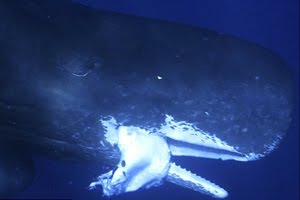
Ancient bite


An international team working in Peru found the skull, the lower jaw and some teeth of what has been called 'a new raptorial sperm whale'. The experts named the animal Leviathan melvillei and dated it as 12-13 million years old.

The unusual finding is related to the teeth: more than 36 cm long and with a 12 cm diameter. These could have been used to feed on on medium-size baleen whales as Olivier Lambert - one of the researchers - suggests: "... it has the largest teeth, and possibly the most powerful bite. With such large teeth on upper and lower jaws, robust mandible and vast area of origin for jaw muscles, we think Leviathan was able to feed on large prey."


Olivier Lambert, Giovanni Bianucci, Klaas Post, Christian de Muizon, Rodolfo Salas-Gismondi, Mario Urbina, Jelle Reumer. The giant bite of a new raptorial sperm whale from the Miocene epoch of Peru. Nature 466 (7302): 105 DOI: 10.1038/nature09067

Abstract: The modern giant sperm whale Physeter macrocephalus, one of the largest known predators, preys upon cephalopods at great depths. Lacking a functional upper dentition, it relies on suction for catching its prey; in contrast, several smaller Miocene sperm whales (Physeteroidea) have been interpreted as raptorial (versus suction) feeders, analogous to the modern killer whale Orcinus orca. Whereas very large physeteroid teeth have been discovered in various Miocene localities, associated diagnostic cranial remains have not been found so far. Here we report the discovery of a new giant sperm whale from the Middle Miocene of Peru (approximately 12–13 million years ago), Leviathan melvillei, described on the basis of a skull with teeth and mandible. With a 3-m-long head, very large upper and lower teeth (maximum diameter and length of 12 cm and greater than 36 cm, respectively), robust jaws and a temporal fossa considerably larger than in Physeter, this stem physeteroid represents one of the largest raptorial predators and, to our knowledge, the biggest tetrapod bite ever found. The appearance of gigantic raptorial sperm whales in the fossil record coincides with a phase of diversification and size-range increase of the baleen-bearing mysticetes in the Miocene. We propose that Leviathan fed mostly on high-energy content medium-size baleen whales. As a top predator, together with the contemporaneous giant shark Carcharocles megalodon, it probably had a profound impact on the structuring of Miocene marine communities. The development of a vast supracranial basin in Leviathan, extending on the rostrum as in Physeter, might indicate the presence of an enlarged spermaceti organ in the former that is not associated with deep diving or obligatory suction feeding.

---
For more information:
http://www.sciencedaily.com/releases/2010/10/101013212637.htm
http://www.independent.co.uk/news/science/gigantic-jaws-of-ancient-whale-could-bring-down-moby-dick-2015265.html

---
Photo (c) Tony Wu: adult 'modern' sperm whale carrying the remains of a squid.

27 October 2010

Northern Gulf of Evia: end of phase 1

Today we completed our first phase of work in the Northern Gulf of Evia, Greece—a project funded and administered by OceanCare in the context of a collaboration with Tethys.

We did 1,343 km of navigation encompassing the whole Gulf (an area of 1,265 squared km), resulting in 13 encounters with bottlenose dolphins, 3 with monk seals, 5 with large (80+ cm) tuna, 20 with flying fish, and one with a sea turtle. 

Giovanni Bearzi and Silvia Bonizzoni

13 October 2010

Cetacean Sanctuary Research 20 (27 September – 26 October)

End of the 2010 field research season

The 2010 season in the waters of the Ligurian Sea and Pelagos Sanctuary has been impressive: 13000 km travelled at sea, totalling 905 h of navigation and 297 cetacean sightings: 210 of striped dolphins, 44 of fin whales, 32 of sperm whales, 5 of Risso’s dolphins, 4 of beaked whales and two of long-finned pilot whales. How many animals? Who knows, we are still trying to figure it out. And then sea turtles, ocean sunfish, tuna, swordfish, seabirds.

But out at sea there were not only dolphins, whales and all sort of other animals. There were people too. Participants from around the world joined the researchers on Pelagos, willing to see animals, enjoy them, contribute to their protection and being a part of our endeavors. How can we forget the volunteers crying while looking at the small striped dolphins bowriding in front of them, turning on their sides and glancing at them as if they were truly feeling a bond with the people on board. The agile and gigantic, confident and majestic sperm whales resting at the surface, dominating the resounding waves. How can we forget those who remained breathless and speechless in front of a fin whale blowing, just a few metres from our boat.

As Ralph Waldo Emerson put it, “Nothing great was ever achieved without enthusiasm”. It is always a pleasure to work with happy and enthusiastic people, curious and interested, able to spread their passion and excitement. Many thanks to all of you!

Nino, Eva, Chiara and Sabina (CSR team members)

---

This week was fantastic, I’ve learned so much about all kinds of animals. I would recommend this trip to anyone but I would say to book two weeks because by the time the first week is over you have just settled in and found where everything goes. Thank you to all the crew for making this trip memorable.

Ruth (UK)

---

A stellar expedition that exceeded my expectations in many ways: from the delicious meals, to the informative conversations and lectures, the opportunity to have been a participant in these research activities has been an experience of a lifetime. Thanks for a great week of superlatives Tethys!

Julieanne (Canada)

---

This week was one of the most spectacular times we have ever had. The wonderful nature, the giant animals, the life on board and the patience and kindness of the researchers are only a few points that made this time so fantastic for us. We learnt a lot about the animals in the Mediterranean Sea and when we come so close to them, we felt the beauty and the uniqueness of these wonderful animals. It is a great pleasure to find people, who watch and protect them from human foolishness and unawareness. Thank you to all of the researchers of Tethys. All of you do a very great job and we are glad to know you. We will come back again!

Heimo, Sabine and Angela (Germany)

---

I have had such a brilliant time onboard Pelagos!  Seeing so many dolphins and whales was amazing, especially seeing the Risso’s dolphins! I have learnt so much and definitely have a greater appreciation for conserving the marine environment, I won’t eat tuna that has been fished using unsustainable methods again! Everyone has been so kind and welcoming and the food has been yummy! I definitely want to come back again next year!

Abbie (UK)

---

I expected it to be good but it was so much better than good in so many different ways. Some moments of pure unadulterated joy that will last me forever. Thank you.

Judith (UK)

---

It was a really fantastic week. It was much better than we had expected. The weather was very good. The boat was nice. We had a lot of fun and we got a very good impression of the researchers’ work. They are really professional and very passionate in their work. And in addition to that they are so polite, helpful, friendly and wonderful people. They managed to do their research and involve the participants into their work at the same time. And still, there was always time for explanation and fun! We would like to come again. Thank you and stay as you are!

Christoph and Claudia (Germany)

11 October 2010

Dolphins of Greece 18 (2-9 October 2010)


I have had a wonderful week, seeing so many different dolphin behaviours and many sea birds including flamingos, cormorants and terns. Marina and Joe have made it special with their enthusiasm and anecdotes of a broad range of experiences in the field. I shall return to work refreshed and with an enhanced understanding of the importance of dolphins in their ecosystem.

Kate (UK)

---

It was an amazing week from several points of view – to meet so different and interesting people and to work together in such a wonderful project. I learned a lot about the dolphins, their life and behaviour, about the sea – how big, how great and at the same time how unprotected it is. When you learn something new, that really touches your mind, you start to think in a different way and consequently you change your deeds. Moreover, you try to share this experience with the other people and hopefully can make the surrounding world a little bit better. I also hope that the data we have managed to collect will be helpful for the further scientific work. This week in Vonitsa impressed me a lot and I would like to say thank you very much to Marina and Joe and all the people from our Team.

Eugenia (Russia)

---

Thanks to the weather, to a great team, to the dolphins and to Greece. It was a wonderful time and experience I have got. I do not think I would be able to get such an experience anywhere else and I hope I made a tiny contribution to the process of improvement of the environment. Let’s hope that the next teams and generations see how beautiful it is. Dolphins are wonderful creatures and have their right to survive as all the rest creatures in the world. The project was organised on very high professional level, exactly what was required for the effective work and team building exercise. My personal gratitude to Marina and Joe, for their professionalism and kind attention to the team, they were able to create the right atmosphere to give the feeling to every member of the importance of their contribution. The whole team was excellent, and everyone had a chance to use his or her knowledge and experience. I learned a lot, I hope to continue to cooperate with Earthwatch institute to take part in future projects. I wish all the best and every success to Tethys in their difficult and generous task. Thanks again and all the best!

Sergey (Kazakhstan)

---

Our week in Vonitsa has been amazing. Marina’s enthusiasm for her subject (botany excluded?) and life in general made all the week a joy, not just the dolphin recording and watching. Flamingos, seagulls, schools of small fish boiling the sea waters, exploring islands and local community living, all added to the experience in which watching dolphins bow-riding was the highlight. Joe’s helpful, good-humour and interest in the work encouraged us. He and Marina worked (worked well together to make up the whole brilliant team) with an interesting group of fellow volunteers. Thank you to all who made the week possible.

Judith and George (UK)

06 October 2010

Monk seal # 2

Second encounter with a monk seal in the Gulf of Evia. This animal, who was different from the one sighted yesterday (see previous post), was observed for an hour engaging in food search in a murky bay, not far from an industrial plant. She performed dives approximately 4-6 min long followed by about 30 sec of ventilations. During those 30 sec spent at the surface we could watch the seal in all her beauty while she was elegantly swimming, staring at us from time to time (photo). While she did not seem exceedingly wary of the boat, she never came closer than 30-50 m. This is a wise behaviour, considering that monk seals in the coastal waters of Greece are still sometimes seen as vermin, and shot.

Giovanni Bearzi