11 September 2007

La carne di balena non piace più?

Il 24 agosto il Ministro della Pesca islandese, Einar Guofinnsson, ha dichiarato che l’Islanda smetterà di cacciare, a fini commerciali, le balene.

I motivi di questo stop sembrano essere dovuti a questioni puramente economiche. Guofinnsson afferma infatti che “l’industria della caccia baleniera deve, come ogni altra industria, obbedire al mercato” e che “se non c’è profitto, non ci sono le basi per ricominciare a uccidere le balene”.

La carne di balena, infatti, sembra riscuotere un successo modesto nei paesi famosi per le uccisioni di questi cetacei. In Islanda solo l’1,1% della popolazione mangia carne di balena una o più volte a settimana, mentre in Giappone ci sono migliaia di tonnellate di carne invenduta e riutilizzata per farne mangime per cani.

Sembrerebbe una buona notizia, ma è forse presto per festeggiare.

Silvia Bonizzoni

---
Per ulteriori informazioni:
http://www.greenpeace.org/italy/news/islanda-balene

10 September 2007

Maddalena Jahoda presenta le 'sue' balene


Il libro Le mie balene, Ed Mursia, sui cetacei dei nostri mari, sulle ricerche, ma anche sulla storia di Tethys, verrà presentato in settembre a Milano dall'autrice, Maddalena Jahoda.

L'incontro sarà ospitato dall'Acquario, lunedi 24 settembre, ore 20.00. In alternativa, ci sarà un incontro anche sabato 22 settembre, ore 21.00 presso la Libreria Equilibri, sempre a Milano, in via Farneti 11.

Sono previste altre date, tra cui, in Veneto, Susegana (TV), domenica 16 settembre, nel castello di San Salvatore nell'ambito della manifestazione" Libri in cantina", e a Genova e La Spezia in ottobre.

Dettagli e altre date si troveranno via via su:
http://www.mursia.com/presentazioni/le%20mie%20balene.html

08 September 2007

In which ways does Tethys cooperate with OceanCare and WDCS?


The Tethys Research Institute is a scientific organization that aims to document cause-effect relationships through rigorous research at sea. As scientists, we are committed to data collection and analyses that – ideally – should constitute the core of our activities. But research at sea has high costs and fundraising ends up being one of the most important and time-consuming issues, also considering that Tethys is independent from governments, from the industry and from the military.

The possibility of relying on consistent financial and other support coming from fellow NGOs releases pressure, allows long-term projects to unfold, and enables us to focus on our scientific work rather than on boring proposal- and report-writing.

Every minute spent on fundraising is a minute subtracted from the actual meaningful work we do. Therefore, it is good to have at least someone who trusts you based on the work you have done over the past 20+ years, and offers seed funding to support its continuation. To a researcher, it is frustrating to spend so much time writing proposals. Ideally, funding should be based on your reliability as a scientist and on a proven capability to produce meaningful actions and publications, out of little money.

OceanCare and WDCS - the Whale and Dolphin Conservation Society – have been supporting our work for a long time. Eventually, this has developed into a relationship of friendship and mutual trust. We now work side by side to promote the protection of animals and habitats that are close to our hearts.

Tethys and its fellow NGOs team up to promote conservation actions ranging from lobbying at international meetings to public awareness and education initiatives. Tethys provides consultancy and scientific support, and NGOs including OceanCare and WDCS use this expertise to strengthen their conservation actions.

Giovanni Bearzi

06 September 2007

What do the volunteers do, why do they come and help, and what touches them the most?


At Tethys, we have been welcoming volunteers at our field stations and on board our research boats since 1990. These people support our projects financially by participating in 7-9 day courses, and this allows us to work over long periods of time and remain independent. Their contribution is essential. In addition, volunteers engage in field data collection, help us process the data, and provide the researchers with motivation and moral support.

Most volunteers come because they want to see whales and dolphins in the wild, but many eventually realize the implications and challenges of a research project, learn about the problems faced by the animals, and eventually become supporters and advocates of conservation efforts.

Many volunteers joining our field courses see their experience as a special one. Getting close to cetaceans in their natural environment is nothing like watching them on TV. Volunteers are touched by their elegance, beauty and behavioural complexity. They realize how ‘special’ these animals are, and (sometimes) get to understand the link that ties them to their environment. They start seeing them as enormous, and yet fragile creatures exposed to a range of threats caused by human activities. They can also spend much time talking with the researchers and understand their motivations and the reasons behind their unusual choice.

I have been working in the field with hundreds of volunteers, and although there may be personal likes and dislikes, it has been an amazing and enriching human experience. Many of them have become good friends, and even colleagues.

Giovanni Bearzi

02 September 2007

What can and has to be done, so that common dolphins will survive?


I could name a number of management actions likely to benefit dolphins and the marine environment: Marine Protected Areas, fishery reserves (areas closed to fishing), strict enforcement of the existing laws (much of the fishing out there is illegal), and so on. But we should avoid just blaming the governments and seeing ecosystem destruction as the result of somebody else’s choices and activities.

We are responsible, too. As voters, in the first place. At the last political elections have we voted ‘with our wallet’, or have we attempted to shift the centre of gravity towards a more sensible environmental policy? Have we ever tried to reduce our own consumption rates, recycle, and make our lives a little more sustainable? Ultimately, the ongoing lack of respect towards the marine environment results from our own desires and demands. People sitting in their comfortable car and never considering taking a train instead of an airplane should consider that a link might exist between their own behaviour and air pollution, or even climate change. Those who enjoy eating swordfish and tuna at the restaurant may want to think about the implications for the marine environment.

Whilst there are practical and feasible actions that can at least stop the decline of common dolphins in some areas (at Kalamos this would include an immediate ban of the most detrimental fishing activities), I think that we should realize that damage to the marine environment is also a result of our life styles and collective habits. Changing our own behaviour and giving up something felt as desirable can be as pleasant, and even more fulfilling, than increasing our consumption rates. The reward consists in knowing that we are part of the solution, rather than part of the problem. We do not only blame others for declining biodiversity and beauty all around us. We are actually doing our best to protect the things we treasure, and we enact consistent behaviour. Our choices might even influence those of others and eventually turn into new behavioural trends.

Giovanni Bearzi

01 September 2007

What future for Mediterranean common dolphins?


The future for Mediterranean common dolphins is grim. They have declined greatly during the past 40 years, and their chances of recovery are shadowed by ongoing mortality in fishing gear and overfishing of their key prey.

Common dolphins need a healthy marine environment to survive, but few people in the region seem to be interested in their conservation. Development and exploitation are by far more attractive. Ever-increasing consumption rates and short-term economic benefits bear a cost, and most of the times this cost is paid by the environment.

People everywhere want to eat more fish, spend their holidays in hotels with seaside pools and parking lots, have a second or third house with sea view (where they may live for one or two weeks every year). This results in increasing pressures on the coastal marine ecosystems. Fish stocks get depleted, coastal development increases pollution and disturbance at sea, and the animals there find it difficult to survive in habitats exposed to continuous degradation.

We have been studying common dolphins in the costal waters of Greece for almost two decades, around the island of Kalamos. Initially, there was plenty of these animals and the area was almost pristine. Today, fish stocks have been depleted by overfishing and the area is being ruined by a kind of development that does not take into account the need to preserve the environment. As a result, only a few common dolphins are left, and their chances to survive are linked to an unlikely political determination of including fishery and ecosystem management actions in ongoing development plans.

This kind of things are happening everywhere in the Mediterranean, and common dolphins must bend to short-sighted economic interests. Local human communities are equally impacted, as they see their traditions and cultures being wiped out by companies building immense and ugly hotels near beautiful beaches and villages, while a few large commercial fishing boats take most of the fish away, and little is left for the artisanal fishermen (and the dolphins).

Giovanni Bearzi

30 August 2007

Lipote avvistato in Cina?

Pare che un delfino di fiume sia stato filmato nello Yangtze. La specie era stata ritenuta probabilmente estinta.

L'avvistamento di un solo lipote lascia ben poche speranze, ma certo una fortissima volontà di scongiurare l'estinzione della specie con misure di tutela concrete e adeguate al caso potrebbe - a questo punto - aprire qualche spiraglio.

Purtroppo la probabilità che ciò avvenga è quanto mai remota.

Giovanni Bearzi

---
Per informazioni:

http://www.reuters.com/article/scienceNews/idUSPEK27670720070829

http://www.repubblica.it/2007/08/sezioni/ambiente/delfino-cina/delfino-cina/delfino-cina.html
Nota: il video sul sito di Repubblica sembra riferirsi a Qi Qi, il lipote tenuto in cattività e morto nel 2002. Di certo non si riferisce all'avvistamento recente.

Wake of the Baiji

How do you protect a species which is threatened by extinction?


Most of the time, it is an extremely lengthy process that includes research to document the extent of decline, identification of the most appropriate management measures considered necessary to stop the decline and allow for species (or population) recovery, involvement of international agreements, legislative frameworks, NGOs and the media, public awareness and education actions targeting the general public, and communication with policy makers to make them aware of the need to act.

Good scientific evidence is one of the most useful tools, but science alone can do little. A scientist should realize that personal engagement is also necessary. A single person can do a lot in terms of communicating the problem and looking for solutions. In the end, however, it is up to the politicians to listen to this message, and do something to protect the animals. Unfortunately, the typical reaction by policy makers is to call for more research, more planning, a workshop, or whatever can slow down and delay the actual implementation phase. This is what I call ‘conservation on paper’. Scientific reports, conservation plans and good intentions do not actually prevent species extinctions as long as they remain on paper. Timely action is also necessary.

Giovanni Bearzi

---
Bearzi G. 2007. Marine conservation on paper. Conservation Biology 21(1):1-3. (103 Kb)

28 August 2007

Una nuova epidemia uccide le stenelle striate del Mediterraneo spagnolo


Una nuova epidemia da morbillivirus sta con molta probabilità uccidendo i delfini della specie stenella striata (Stenella coeruleoalba) al largo delle coste spagnole. Dalla metà di luglio si sono verificati circa 40 spiaggiamenti e in tre di questi casi è stato confermato che si tratta di morbillivirus – un virus simile al cimurro dei cani, letale per i delfini.

Nel 1990 si era verificata una moria da morbillivirus molto estesa, che aveva raggiunto le coste italiane decimando l’intera popolazione mediterranea. Così come nell’episodio precedente, gli animali sono spesso denutriti e con parassiti esterni. Molti arrivano a spiaggiarsi mentre sono ancora in vita. Il numero di morti è ancora molto inferiore al 1990, ma non è noto se questo sia dovuto a una minore aggressività del virus, al fatto che la popolazione di stenelle striate è diminuita rispetto al 1990, o a una combinazione dei due fattori.

Fino ad ora, la cronologia degli eventi segue un modello simile a quello del 1990. In quell’anno la moria iniziò a Valencia verso metà luglio e si diffuse verso nord e verso sud, raggiungendo un picco di mortalità verso settembre lungo le coste spagnole del Mediterraneo. In Francia, i primi individui spiaggiati comparvero verso i primi di settembre e il picco si verificò tra la fine di settembre e i primi di ottobre. L’Italia fu raggiunta verso metà settembre. In totale, morirono molte migliaia di animali.

Nonostante la causa primaria dell’epidemia del 1990 fosse un’infezione da morbillivirus, è noto che sostanze chimiche prodotte dall’uomo - come PCB e altri contaminanti organici - possono aver scatenato l’evento o incrementato la sua estensione e letalità, a causa del potenziale immunosoppressivo di queste sostanze.

Un’altra grave causa di mortalità per le stenelle striate del Mediterraneo sono le catture accidentali nelle reti derivanti, usate ancora sotto mentite spoglie o illegalmente in paesi come Francia, Italia e Turchia.

La stenella striata, piccolo delfino d’alto mare, è la specie di cetaceo più abbondante in Mediterraneo. Studi morfologici e genetici indicano che la popolazione mediterranea è separata da quella dell’Atlantico, con scarso flusso di individui attraverso lo Stretto di Gibilterra. Anche per questo motivo è importante che la ‘nostra’ popolazione sia opportunamente tutelata.

Giovanni Bearzi

---
http://www.lavanguardia.es/lv24h/20070828/53389058918.html

27 August 2007

One day in the field


In a recent interview for a Swiss magazine, I was asked to describe a typical day of a researcher on site...

In my experience, this involves waking up early in the morning, rushing to the research boat after having checked and set up all the equipment, spending hours scanning the sea surface in search for dorsal fins. Sometimes dolphins will be found and sometimes not, but you know that you will come back with useful data that help explaining what is going on out there. And then spending the rest of the day entering data, lecturing to volunteers, training the assistants, discussing and solving personal issues that are inevitable when one shares the same roof with colleagues and students, fixing boats, engines and computers that never stop making trouble, refilling the fuel tanks, buying stuff at the supermarket (if one exists), running, running, running.

On some days you will have a good time over dinner, but on other occasions you may be forced to share the table with people who have little in common with you. Ups and downs, moments of glory and moments of deep frustration. Now enjoying a moment of peace with dolphins all around the boat, and then fixing a leaking toilet in a hell-like summer heat. But always having a sense of living your life at full speed, not wasting a minute, and being fully engaged in something that has a meaning.

To me, what gives a sense to this kind of hectic life in the field is the feeling that you are contributing to an attempt to preserve wildlife. If one loses track of this fundamental goal, life as a field researcher does no longer make sense. You are paid little money to work a lot and take care of a number of logistical, relational and other problems that do not look like research at all. Therefore, it is important to realize that conservation-oriented research needs people who are equally determined and capable of recording good behavioural data during a dolphin sighting, talking to the mechanic about that weird noise made by the engine, transcribing the contract for the renting of the field station, or moping the floor. All that is equally important, and nobody is allowed to sign off the most miserable of duties.

Giovanni Bearzi

26 August 2007

How does one become a dolphin researcher?


My suggestion is to come up with reasonably clear ideas about what you want to do, where and how. Ideally, one should aim to something felt as important, and also feasible based on one’s skills and existing opportunities.

I started working on cetaceans by volunteering on board oceanographic research vessels - looking for dorsal fins and flukes during the day and working in the wet lab during the night. Then I used my father’s small inflatable boat to start a study on dolphins around Losinj, Croatia. Eventually, this became the longest-running study of bottlenose dolphins in the Mediterranean.

Don’t miss opportunities to make experience. You may try to participate in some field or lab activity, doing work as close to your interests as possible to gain practical experience on that particular subject. Find out what is the area where you do particularly well (this may include lab work, photography, statistics or even management, environmental policy, public awareness). If you ‘feel good’ doing something and have a sense of being ‘at home’ whenever you do that, then you may have found your own specialty. Go for it, and try to develop a specific project or an interesting proposal to motivate other people and attract funding.


Do not rely too much on letters and CVs. Try to meet the relevant people in person, at their offices or even in the field. Attend marine mammal and marine conservation conferences, visit various institutes and NGOs. Show that your choice of working with a person or organization is motivated and based on some kind of ‘affinity’.

Courses organized by Tethys (www.tethys.org) can be a reasonable first step for gaining basic experience, knowing how you feel on a boat or at a field station, chat with researchers and possibly identify your areas of interest. You may consider trying different experiences and research groups before deciding what works best for you. In any case, do not put everything in somebody else’s hands: the choice should be yours.

As a general rule, you have better chances of success if you do something based on enthusiasm and passion, and you do not lose sight of your goals along the way.

Giovanni Bearzi

---
Useful link:
SMM - Strategies for Pursuing a Career in Marine Mammal Science

24 August 2007

Working with Tethys as an assistant


Working with Tethys as an assistant, during much of this summer, provided me with an opportunity to widen my knowledge. Not only about the dolphins, but also about myself.

Going to a foreign country (I'm Hungarian) and facing the challenges of a different culture is always a pleasant experience. But doing research in the field has been even more challenging, and brought about the big issue of what I really want to do in my life.

While I was working on board, collecting data and recording the behaviour of dolphins, my interest in these wonderful marine mammals has ever increased. But this did not happen on my first sighting. To be honest, on my first survey I just wanted to do a proper job, and this wasn't an easy task because I was required to do so many things at once. At times I felt completely lost…

But there was always someone who helped me out of the mist. This was the pleasant part of working in a team. Together, you work hard to achieve the same goals, collect data in the best possible way, and pay much attention to the details. A large number of details!

During my first sighting I was fully focused on my duties and unable to realise how wonderful these animals are. This would come later on, when I felt more comfortable with my duties. Then, I realized how amazing every single sighting can be.

I could find beauty in every survey. Even if we did not find dolphins, there were so many interesting situations in the wild - you just had to pay attention.

Once we stopped next to a mussel farm, waiting for a sea turtle to surface. While we were in a complete silent, the wide vocal repertoire of a number of terns standing fiercely on the mussel buoys hit our ears. It was an amazing listening to their communication, in their own territory.

If you work at sea, you need to observe wildlife and appreciate that all animals are part of the ecosystem. Even if your focus is primarily on dolphins, it is by paying careful attention to whatever happens around you that you can call yourself a researcher.

If you do so, your days end with a feeling that tomorrow, again, you can go out at sea and be blessed by a sense of wildlife. You can step out of your narrow human path and participate in the larger painting of Nature.

This has been my first experience doing field work, and I must say that it doesn't compare to my previous work in the neurophysiology lab, which I still love. Being in contact with the animals in their natural environment makes a difference, and now I know that this is what I really wanted to do.

I owe a lot of thanks to Joan, Giovanni and Silvia, who taught me so many things. Besides my duties I had opportunities of doing photo-identification, driving the boat, spending long hours on dorsal fin matching, and committing to many other activities that are essential to the project. I also enjoyed sharing my little knowledge with the volunteers. Seeing how interested they are provided me with extra energy, and gave additional meaning to what I was doing.

Overall, this summer has been one of my best. I got involved in a research project, I tried out my skills as a field researcher, and I was motivated to move confidently towards meaningful goals.

Susanna Pereszlenyi

23 August 2007

Pelagos, 13-19 agosto 2007


Una finestra di quattro giorni di tempo stabile ci ha permesso di fare rotta verso sud, partendo all’alba da Sanremo. Durante la tranquilla navigazione verso la Corsica, per ben nove volte sono stati avvistati branchi di stenelle striate, il che ci ha consentito di raccoglie dati sul comportamento acustico e campioni di pelle per la genetica delle popolazioni pelagiche.

All’imbrunire, mentre l’equipaggio organizzava i turni per la notte, l’idrofono ha registrato i click di un capodoglio. A causa della poca luce e della distanza dell’individuo è stato possibile solo scorgere la pinna caudale. Poi l’equipaggio si è spartito i turni di guardia mentre Pelagos navigava sotto un cielo di stelle cadenti.

Il giorno dopo Pelagos ha raggiunto la sua destinazione e l’equipaggio è stato impegnato in un’impegnativa cena di ferragosto. All’alba del giorno successivo, Pelagos ha ripreso la sua rotta verso le costa ligure. Dopo 60 miglia, il soffio di una balenottera comune ha ripagato gli sforzi di tutto l’equipaggio.

Le ultime 30 miglia sono state caratterizzate da tempo instabile che ha costretto Pelagos a dirigere verso la base dove abbiamo trascorso la giornata di venerdì.

Nei giorni successivi la ricerca si è svolta nelle acque della Costa Azzurra, dove abbiamo fatto un avvistamento di grampi durato più di due ore, il terzo della stagione. Con i dati di fotoidentificazione del gruppo e con una buona pizza preparata dallo skipper, l’equipaggio è rientrato nel tranquillo ormeggio di Portosole.

Il team CSR

---

Vraiment une belle semaine, humainement et cetaceans point aussi !!! une belle equipe de Tethys, beaucoup de motivations, et de belles rencontres avec les volontaires… ce doit etre la magie de la mer. Et aussi de beaux reflets d’eau pour la magie de l’oeil qui photographie. Merci encore a tous et aux mammels animals. Quella bella vita con voi !!!!! Gracie Mile
Stéphanie, France

22 August 2007

Pelagos, 6-12 agosto 2007


All’inizio della tredicesima settimana il maltempo non ha permesso di trascorre molte ore in mare. Ciò nonostante, siamo riusciti ad avvistare diversi gruppi di stenelle striate e a raccogliere dati sul comportamento acustico di questi socievoli delfini.

Dopo una giornata trascorsa al Museo Oceanografico di Montecarlo per approfondire le conoscenze sull’evoluzione e l’anatomia dei cetacei, l’equipaggio di Pelagos ha nuovamente preso il mare. La seconda parte della settimana ha ripagato le attese di tutti.

Sabato pomeriggio abbiamo sentito il tanto atteso e ormai familiare click di un capodoglio, specie che sta caratterizzando la stagione 2007. Nelle sei ore passate con questo affascinante animale è stato possibile fotoidentificarlo e raccogliere importanti dati comportamentali e acustici.

Anche domenica abbiamo trascorso diverse ore con tre individui, due dei quali fotoidentificati.

Lo sforzo e la collaborazione dei partecipanti sono stati fondamentali per la raccolta dei dati, e tutti si sono entusiasmati all’ascolto dei click di capodoglio con l’idrofono. Una partecipante ‘speciale’ di tredici anni ha realizzato il suo sogno di osservare balene e delfini nel loro ambiente naturale, e i ricercatori Tethys hanno deciso di battezzare con il suo nome – Anina – il primo capodoglio avvistato.

Il team CSR

---

On Saturday, I didn’t believe anymore that we would be seeing a whale but then we heard the clicking with the hydrophone and I had hope again. This whale was the most wonderful thing I have ever seen in my whole life! And the dolphins… what should I say? I just couldn’t stop smiling when I saw them! The only word that can describe that: WOW!!! Thanks very much to the Tethys team for this interesting, wonderful, beautiful, exciting and supercool week!!!!!!!!! PS: Special greetings also to my “underwater-name-sister”
Anina, Switzerland

The hospitality, enthusiasm, professionalism, generosity and sensitivity of the researchers on board was as mind-blowing as seeing a sperm-whale’s fluke for the first time and their undiluted pleasure when we heard the whistles and clicks of the dolphins on the hydrophone was humbling. And seeing the whales and dolphins in the wild moved me in a way I cannot explain. This was an experience of a lifetime. I learned so much, not just about cetaceans. Thanks a million to Tethys for facilitating this.
Sandy, South Africa / Netherlands

19 August 2007

A mother bottlenose dolphin mourning her dead newborn calf in the Amvrakikos Gulf, Greece


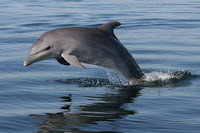
On the 3rd and 4th of July, 2007, one common bottlenose dolphin Tursiops truncatus was observed interacting with a dead newborn calf in the semi-closed waters of the Amvrakikos Gulf, Greece.

The behaviour of the presumed mother was observed by Tethys researchers Joan Gonzalvo Villegas and Zsuzsanna Pereszlenyi and by Earthwatch volunteers for approximately 4.5 hours under an oppressive summer heat, in a dead-calm sea.

Whilst researchers must avoid being driven by their own feelings and make arbitrary interpretations, in this case it was quite clear that the mother was mourning. She seemed to be unable to accept the death, and was behaving as if there was any hope of rescuing her calf.

She lifted the little corpse above the surface, in an apparent late attempt to let the calf breath. She also pushed the calf underwater, perhaps hoping that the baby could dive again. These behaviours were repeated over and over again, and sometimes frantically, during two days of observation.

The mother did never separate from her calf. From the boat, researchers and volunteers could hear heartbreaking cries while she touched her offspring with the rostrum and pectoral fins. Witnessing such desperate behaviour was a shocking experience for those on board the research boat.

From time to time, other dolphins from the Amvrakikos Gulf population (estimated by Tethys researchers at approximately 150 individuals), approached briefly to see what was going on. But they did not show much interest, and the mother was soon left alone with her grief.

A source of concern for the researchers was that the mother was never observed diving or feeding during about 2 hours of observations on the first day, and another 2.5 hours on the second day. Bottlenose dolphins are large warm-blooded marine mammals with high metabolic rates, and are supposed to take much food to stay healthy. Spending long hours or even days after a dead calf could potentially weaken the mother and threaten her survival.

The observations were documented by 532 digital photos taken on the first day, and 138 photos taken on the second day. A selection of 48 photos has been posted online and can be viewed at http://www.tethys.org/projects/IDP/deadcalf2007/. The photos refer to both observation days.

Because of the heat, the calf - floating dead at the surface - was quickly decomposing, and the last photos show a bloated calf lacking large pieces of skin and with wounds caused by the decomposition processes. The mother was seen removing pieces of skin and tissue from the corpse - possibly an attempt to 'clean' the calf.

The researchers on board did not feel like taking the calf away from the mother to perform scientific investigations (e.g. a necropsy of the calf). Their decision was intended as a form of respect towards a highly-evolved animal, the deep suffering of whom was obvious enough. All the researchers did was recording behavioural information at 1-min intervals, throughout the observations, and collect a small sample of the calf's skin for future genetic analyses.

The mother is a known animal (ID: 03046) who has been observed in the Gulf since 2003. In September 2004 she had another calf, who apparently survived.

Although Tethys researchers conduct photo-identification surveys in the Gulf almost on a daily basis, at the time when this report is being written the mother was not encountered again. The researchers are now planning to write a scientific note to report this event in full detail. It would be interesting to see if the mother will be encountered in the future, and how she behaves. We hope that eventually she let go, accepting the loss of her baby as an event that - albeit grim - is not infrequent among wild dolphins.

Giovanni Bearzi

---

For additional information on bottlenose dolphins in the Amvrakikos Gulf see:

Bearzi G., Agazzi S., Bonizzoni S., Costa M., Azzellino A. 2007. Dolphins in a bottle: abundance, residency patterns and conservation of bottlenose dolphins Tursiops truncatus in the semi-closed eutrophic Amvrakikos Gulf, Greece. Aquatic Conservation: Marine and Freshwater Ecosystems 17. doi: 10.1002/aqc.843.